
The world of finance can feel complex. Investing often seems like something only for experts. But what if there was an easier way? Enter robo-advisors in finance. These automated platforms are changing how people manage their money.
They make investing accessible and often more affordable. This article will break down what robo-advisors are, their benefits, potential risks, and real-world examples.
What Are Robo-Advisors in Finance?
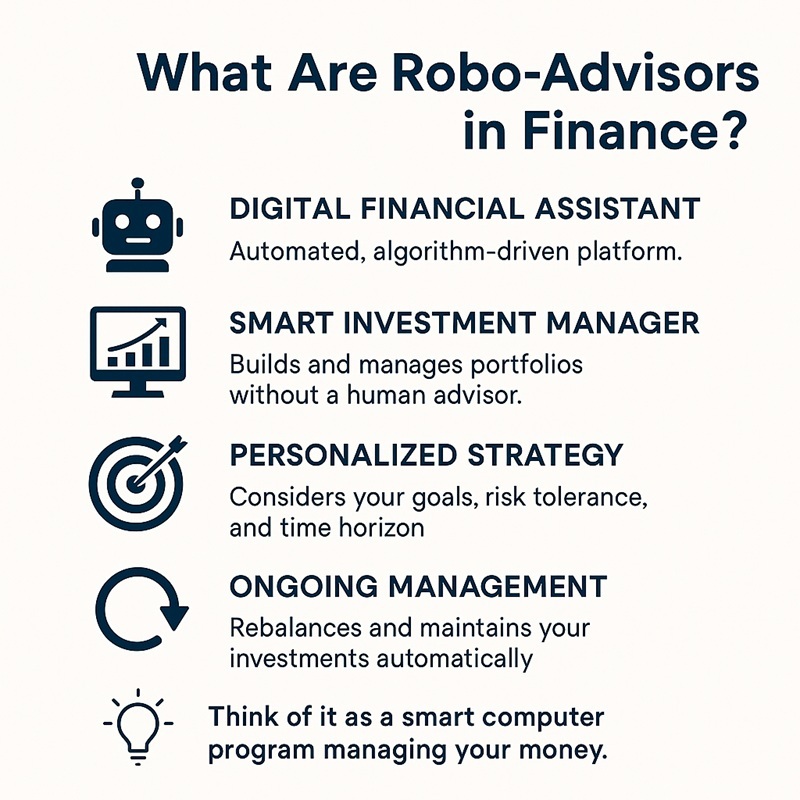
At its core, a robo-advisor in finance is a digital platform that provides automated, algorithm-driven financial planning services. Think of it as a smart computer program that manages your investments. Instead of a human financial advisor, a computer handles the tasks.
These platforms use algorithms to build and manage investment portfolios. They consider your financial objectives, risk tolerance, and time horizon. Based on this information, they recommend a suitable investment strategy. Once you approve, they manage your investments for you. This includes tasks like rebalancing your portfolio.
How Do Robo-Advisors Work?
The process usually starts with a questionnaire. This survey asks about your age, income, existing assets, debts, and most importantly, your financial goals. Are you saving for retirement? A down payment on a house? Your child’s education?
It also assesses your risk tolerance. Are you comfortable with more ups and downs for potentially higher returns? Or do you prefer a more stable, lower-risk approach?
Based on your answers, the robo-advisor in finance constructs a diversified portfolio. This typically involves low-cost Exchange Traded Funds (ETFs) and mutual funds. These funds often cover various asset classes like stocks, bonds, and real estate. The goal is to spread your money across different investments. This helps reduce risk.
Once your portfolio is set up, the robo-advisor doesn’t just leave it. It continuously monitors your investments. Over time, the value of different investments can change.
If one part of your portfolio grows too much, or another shrinks, it might shift from your target allocation. The robo-advisor will then “rebalance” it. This means buying or selling assets to bring your portfolio back to its original target. This automation is a key feature of robo-advisors in finance.
The Benefits of Robo-Advisors
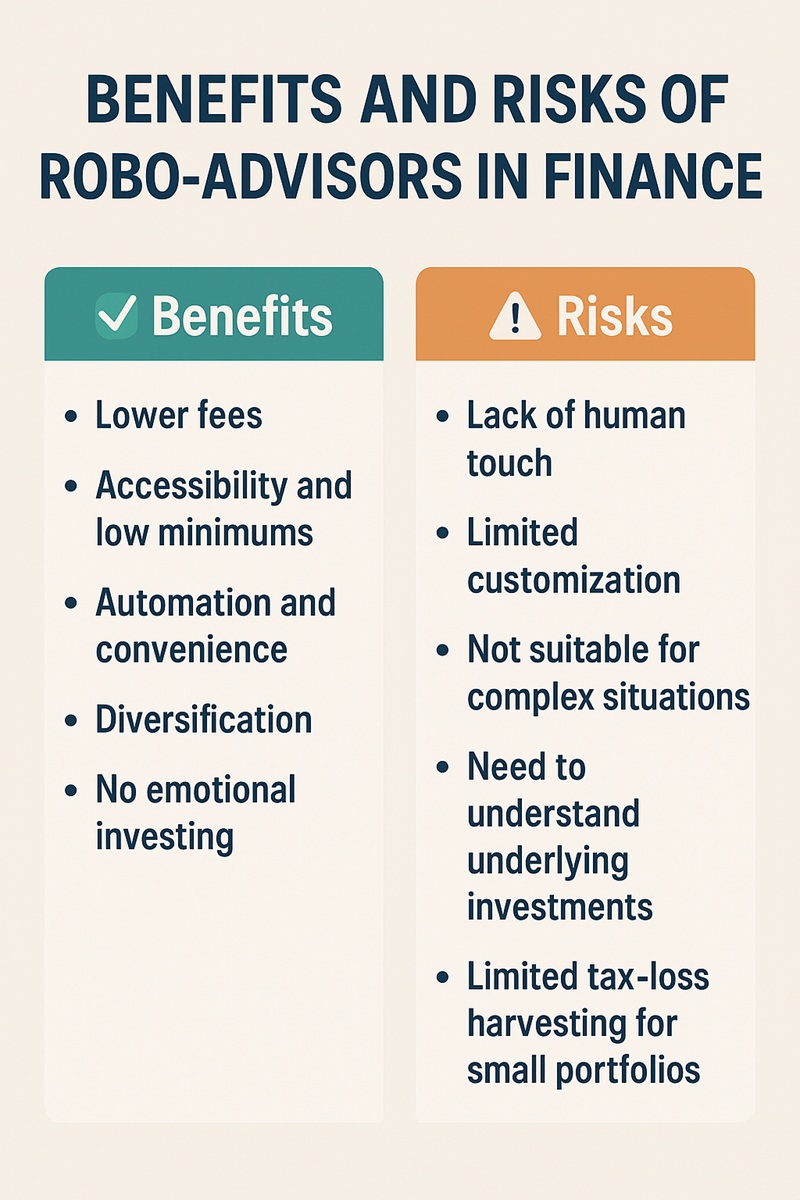
Robo-advisors in finance offer several compelling advantages. These benefits often appeal to new investors, busy individuals, and those looking for a more hands-off approach.
1. Lower Fees
One of the biggest draws of robo-advisors in finance is their cost-effectiveness. Traditional financial advisors often charge a percentage of assets under management (AUM). This can range from 0.5% to 2% or even more. Robo-advisors, on the other hand, typically charge much lower fees. Often, they charge between 0.25% and 0.50% of AUM. This difference can save you a significant amount of money over time, allowing more of your returns to stay in your pocket.
Let’s look at an example:
| Feature | Traditional Advisor | Robo-Advisor |
|---|---|---|
| Annual Fee (AUM) | 1% | 0.25% |
| Investment Amount | $100,000 | $100,000 |
| Annual Fee Paid | $1,000 | $250 |
| Savings Per Year | $750 |
Over decades, these savings compound and can add up to tens or even hundreds of thousands of dollars.
2. Accessibility and Low Minimums
Many traditional financial advisors require a significant minimum investment. This can often be $100,000, $250,000, or even more. This makes professional financial advice out of reach for many.
Robo-advisors in finance have changed this. Many platforms have very low minimums, some even starting with just $0 or $100. This opens up investing to a much wider audience. It allows people to start investing even with small amounts. This is crucial for younger investors or those just beginning their wealth-building journey.
3. Automation and Convenience
Once you set up your account and answer the questionnaire, the robo-advisor in finance does the heavy lifting. It builds your portfolio, invests your money, and rebalances it automatically. This “set it and forget it” approach is incredibly convenient.
You don’t need to constantly monitor the markets or make different types of investment decisions yourself. This frees up your time and reduces stress. It also helps prevent emotional decision-making, which can often harm investment returns.
4. Diversification
A core principle of smart investing is diversification. This means spreading your money across different types of investments. The goal is to reduce risk. If one investment performs poorly, others might perform well, balancing things out.
Robo-advisors in finance excel at this. They automatically create diversified portfolios, usually using ETFs that hold hundreds or thousands of different stocks and bonds. This ensures your money isn’t all riding on one horse.
5. No Emotional Investing
Human emotions can be an investor’s worst enemy. When markets are volatile, fear can lead people to sell at the wrong time. When markets are soaring, greed can lead to taking on too much risk.
Robo-advisors in finance are immune to these emotions. They stick to a predetermined strategy. They buy and sell based on different types of data and algorithms, not feelings. This disciplined approach often leads to better long-term returns.
Risks and Limitations of Robo-Advisors
While robo-advisors in finance offer many advantages, they are not without their downsides. It’s important to understand these limitations before committing your money.
1. Lack of Human Touch
Perhaps the most significant limitation is the absence of a human advisor. A human advisor can offer personalized advice beyond just investments. They can help with complex financial situations like estate planning, tax strategies, or business finances.
They can also offer emotional support during market downturns, something an algorithm cannot do. For simple financial needs, a robo-advisor in finance is excellent. For complex or highly personalized situations, a human touch might be necessary.
2. Limited Customization
Robo-advisors in finance typically offer pre-set portfolio models. While they consider your risk tolerance, they may not offer the same level of customization as a human advisor.
If you have very specific investment preferences (e.g., wanting to invest only in certain industries or avoiding others), a robo-advisor might not be flexible enough. They focus on broad market exposure through diversified funds.
3. Not Ideal for Complex Situations
As mentioned, if your financial life is complicated, a robo-advisor in finance might fall short. This includes:
- High Net Worth Individuals: Those with significant assets often need specialized tax strategies, trust planning, and philanthropic advice.
- Unique Income Streams: Business owners or those with irregular income might need more tailored financial planning.
- Specific Life Events: Navigating divorce, selling a business, or managing a large inheritance often requires nuanced human guidance.
4. Understanding the Underlying Investments
While robo-advisors in finance make investing easy, it’s still essential to understand what you’re investing in. The platforms typically use ETFs and mutual funds.
Knowing what these funds hold and how they generally perform is important. blindly trusting an algorithm without any understanding can be risky. While the platform does the work, you are still ultimately responsible for your financial decisions.
5. Limited Tax-Loss Harvesting for Smaller Portfolios
Some advanced robo-advisors in finance offer “tax-loss harvesting.” This is a strategy where you sell investments at a loss to offset capital gains and reduce your tax bill. While effective, this feature usually only applies to larger portfolios (often $50,000 or more). For smaller accounts, the benefits might not outweigh the complexity.
Examples of Popular Robo-Advisors
The market for robo-advisors in finance has grown significantly. Many companies now offer these services, each with its own features and fee structures. Here are a few prominent examples:
1. Betterment
Betterment is one of the pioneers in the robo-advisor space. It’s known for its user-friendly interface and comprehensive features.
- Key Features: Automated portfolio management, tax-loss harvesting, goal-based investing (e.g., retirement, saving for a down payment), and access to human financial advisors for an additional fee.
- Fees: Typically around 0.25% for their Digital plan and 0.40% for their Premium plan (which includes human advisor access).
- Minimum Investment: $0 to start, but $10,000 for the Premium plan.
Betterment also offers different types of investment strategies based on your risk tolerance, including socially responsible investing (SRI) options.
2. Wealthfront
Wealthfront is another leading robo-advisor in finance, often compared to Betterment. It targets slightly more affluent investors but still offers low minimums.
- Key Features: Automated portfolio management, extensive tax-loss harvesting (including daily TLH), “Path” financial planning tool, and sophisticated direct indexing for larger accounts.
- Fees: Typically 0.25% of AUM.
- Minimum Investment: $500.
Wealthfront excels at tax optimization and has tools designed to help you plan for various life goals, such as buying a home or sending kids to college.
3. Schwab Intelligent Portfolios
Charles Schwab, a well-established name in traditional finance, also offers a powerful robo-advisor in finance called Schwab Intelligent Portfolios.
- Key Features: No advisory fees, automated rebalancing, diversified portfolios using Schwab ETFs. However, a significant portion of the portfolio is often held in cash, which has drawn some criticism.
- Fees: $0 advisory fees. They make money from the underlying ETFs and cash holdings.
- Minimum Investment: $5,000.
This option can be attractive for those who prefer a well-known institution and are comfortable with the cash allocation strategy.
4. Fidelity Go
Fidelity, another financial giant, has its own robo-advisor in a financial solution.
- Key Features: Automated investing, diversified portfolios, and no advisory fees for balances under $25,000.
- Fees: No advisory fees for balances under $25,000. For balances over $25,000, it’s 0.35% per year.
- Minimum Investment: $0 to open, but $0 for the advisory fee until $25,000.
Fidelity Go is a strong contender for those who already have accounts with Fidelity or are looking for a trusted brand with an affordable entry point.
Who Should Consider Using a Robo-Advisor?
Robo-advisors in finance are a great fit for several types of investors:
- Beginner Investors: If you’re new to investing and feel overwhelmed, a robo-advisor simplifies the process.
- Cost-Conscious Investors: Those looking to minimize fees will find robo-advisors much more affordable than human advisors.
- Busy Professionals: If you don’t have time to manage your investments actively, the automation is a huge benefit.
- Goal-Oriented Savers: If you have clear financial goals (e.g., retirement, down payment) and want a system to help you reach them.
- Investors with Smaller Portfolios: The low minimums make professional-grade portfolio management accessible to almost everyone.
- People Who Prefer a Hands-Off Approach: If you want your investments managed without much direct involvement, a robo-advisor is ideal.
Who Might Be Better Off with a Human Advisor?
While robo-advisors in finance are great, they aren’t for everyone:
- Individuals with Complex Financial Needs: If you have unique tax situations, own a business, or need intricate estate planning.
- High-Net-Worth Individuals: Those with very large portfolios often benefit from specialized tax strategies and personalized wealth management.
- Those Needing Emotional Support: If you want someone to talk to during market volatility or prefer a personal relationship with your advisor.
- Investors with Specific Investment Preferences: If you want to heavily customize your portfolio or invest in niche assets not offered by robo-advisors.
- Those Who Lack Basic Financial Understanding: While robo-advisors simplify things, a human advisor can also educate and mentor.
How to Choose the Right Robo-Advisor for You
With many robo-advisors in finance available, choosing the right one can seem daunting. Here are factors to consider:
- Fees: Compare advisory fees. Look at expense ratios of the underlying ETFs. Even small differences can add up.
- Minimum Investment: Ensure the minimum investment requirement fits your budget.
- Features: Do you need tax-loss harvesting? Access to human advisors? Goal-planning tools? Look for features that align with your needs.
- Investment Strategy: Understand how the robo-advisor invests. Do they use ETFs? What asset classes do they cover? Does it align with your general philosophy?
- Customer Service: Even with automation, good customer support is important if you have questions or issues.
- Reputation and Security: Choose a reputable platform with strong security measures. Ensure they are regulated.
The Future of Robo-Advisors in Finance

The landscape of robo-advisors in finance is constantly evolving. We’re seeing more hybrid models emerge, combining the affordability of automation with access to human advisors when needed. Artificial intelligence and machine learning are likely to make these platforms even more sophisticated. They will likely offer more personalized advice and predictive capabilities.
As technology advances, robo-advisors in finance will continue to democratize investing. They will make it easier and more affordable for even more people to build wealth and achieve their financial dreams.
Conclusion
Robo-advisors in finance have truly revolutionized the investment world. They offer a powerful, low-cost, and convenient way for many people to manage their money. Their benefits—lower fees, accessibility, and automation—are significant. However, it’s crucial to understand their limitations, especially the lack of a human touch for complex situations.
By carefully considering your financial goals, risk tolerance, and needs, you can determine if a robo-advisor in finance is the right tool for you. For many, they represent an excellent starting point and a reliable partner on the journey to financial well-being. The future of investing is here, and it’s increasingly automated and accessible.



Comments (No)